
FILIPINO STUDENTS HOLD GENERAL ASSEMBLY AT EMBASSY IN SEOULbioclavid wiki kapslerbruger.site bioclavid til hunde
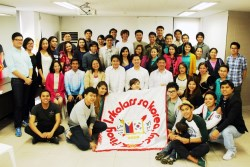
Philippine Ambassador to Korea Raul S. Hernandez poses with the officers and members of the Pinoy Iskolars sa Korea (PIKO) at the 12th PIKO General Assembly held at the Embassy Chancery on 5 October 2014.
SEOUL, 5 October 2014 – Some 40 Filipino undergraduate and graduate scholars studying in South Korea held their biannual General Assembly at the Embassy Chancery on Sunday, 5 October 2014 to welcome new members and inaugurate new officers in the representative Filipino student association.
In a speech at the 12th General Assembly of the Pinoy Iskolars sa Korea (PIKO), Philippine Ambassador to South Korea Raul S. Hernandez reminded the Filipino students of their obligation to do their best not only for their sakes but to offer the skills and knowledge they will acquire during their studies in Korea for the benefit of the Philippines and for humanity.Ambassador Hernandez led the oath-taking ceremonies for the PIKO business manager and representatives of regional chapters in Busan, Daegu-Gyeongbuk and Chungbuk National University in Cheongju, followed by the periodic report themed on “Iba’t ibang larangan, iisang pinanggalingan†(Different fields, one origin) by PIKO President Ronel Laranjo.
PIKO Vice President Joseph Albert Mendoza, a PhD student in Environmental Engineering at Dongguk University, reported on the initial results of a survey filled in by 126 Filipino respondents in Korea between March and September 2014, a figure that represents less than a third of the more than 716 students under the relevant D-2 and D-4 student visa categories.
The most revealing stats are 68 percent of Filipino scholars are in engineering and pure or applied sciences, and only 32 percent are in humanities. In terms of gender distribution, 60 percent are women. As for academic level, 77 percent are doing their Masters, PhD or a combined program, 10 percent are undergraduates and 10 percent are on exchange.
Founded in 2005, PIKO has currently some 200 members in five chapters around the country outside of the main organization centered in Seoul: Myongji University in Yongin, Gyeonggi Province; Chungbuk National University in Cheongju, North Chungcheong Province; Cheonan in South Chungcheong Province; Daegu-Gyeongbuk, and Busan.
According to the Korean Immigration Service, there are some 548 Filipino students in exchange, undergraduate and graduate programs (D-2 visa) in around 60 universities in Korea as of August 2014. In addition, there are 168 holders of D-4 visas either studying Korean or are enrolled in elementary and secondary schools in Korea.
 August 12, 2026
 August 11, 2026
 August 06, 2026